

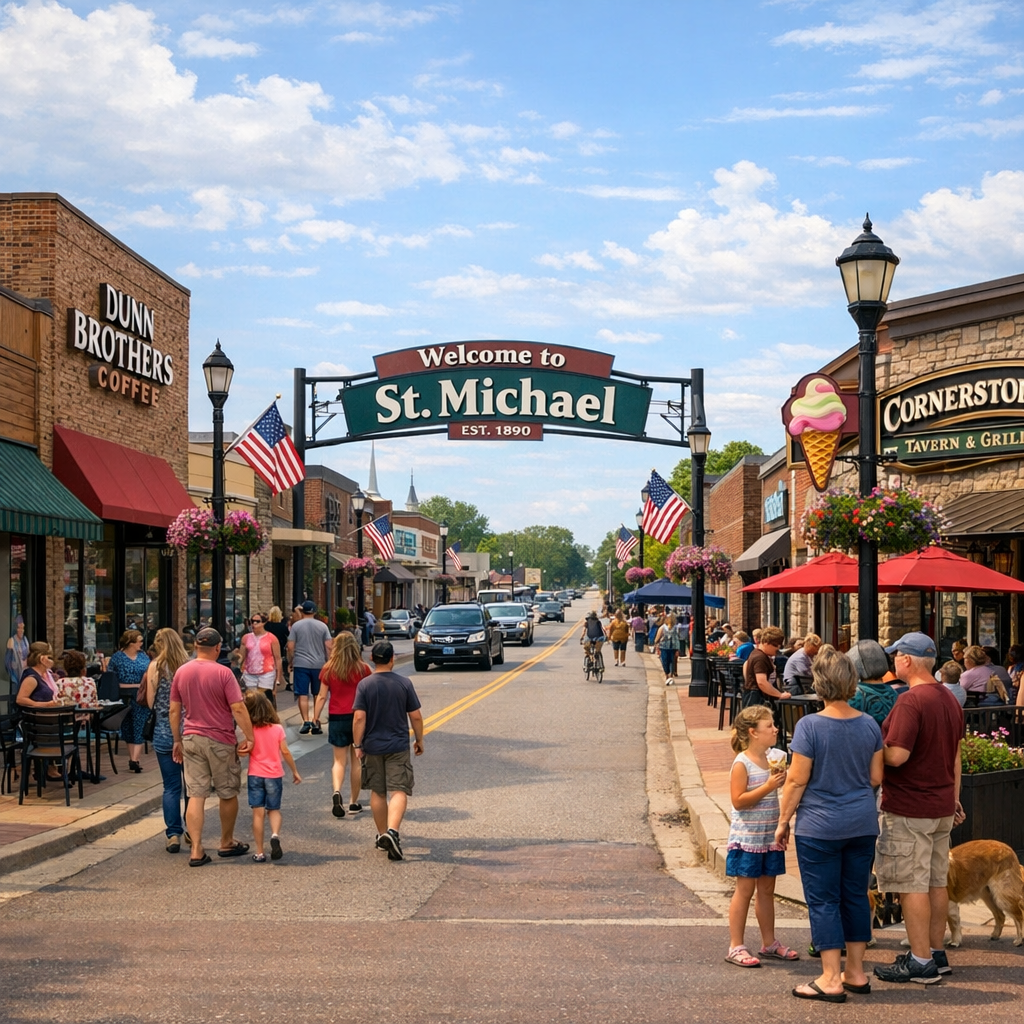
St. Michael, Minnesota, has experienced significant growth in recent years, establishing itself as a dynamic community with a robust economic foundation. As of 2026, the city’s population has reached approximately 23,380 residents, reflecting a 27.89% increase since 2020. This surge underscores St. Michael’s appeal as a desirable place to live and work.
The economic vitality of St. Michael is evident in its median household income, which stands at $130,814. This figure is notably higher than the national median, highlighting the community’s prosperity. The city’s employment rate is also impressive, with 78.3% of residents engaged in the workforce, and 44.3% holding a bachelor’s degree or higher, indicating a well-educated population.
Local businesses play a pivotal role in St. Michael’s economy. The city’s Economic Development Authority (EDA) actively supports business retention and expansion, aiming to diversify the tax base and increase job opportunities. The EDA meets monthly at various local businesses to understand their challenges and opportunities, fostering a collaborative environment for economic growth.
Despite its growth, St. Michael faces challenges common to expanding communities. The proximity to larger commercial hubs like Monticello and Maple Grove presents competition for attracting certain industries, such as large retail chains. Additionally, the city has experienced retail leakage, where residents spend money outside the community for specific goods and services. Addressing these challenges is crucial for sustaining local economic development.
In summary, St. Michael’s economic landscape is characterized by a growing population, strong median income, and active local businesses. While challenges exist, the community’s proactive approach to economic development positions it well for continued prosperity.